
Mapping The White Sharks of False Bay: A Vanishing Act
This research blog will deal with the Great White Sharks of False Bay and their disappearance and other information. Mapping the white sharks of False Bay has become a pressing mission for marine scientists and conservationists around the globe. Once a hotspot for these powerful hunters—better described as “the ocean’s most feared and most misunderstood creatures”—False Bay lost virtually all its great white sharks between 2015 and mid-2018, according to long-term tracking and survey data ([news.mongabay.com][1]).
A Storied History of False Bay’s White Sharks
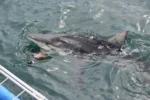
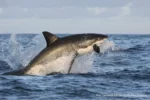
Seal Island, nestled in False Bay about 6–10 km offshore, was historically the crown jewel for shark watchers. Known as the shark breaching capital of the world, it was not uncommon to be witness to these incredible feats of brute power and predation prows, as they would fly, meters into the air, garnering them the very well suited name of “Airjaws.”
Great whites patrolled the waters year-round, drawn by abundant Cape fur seals ([en.wikipedia.org][2]). From 2000 through 2015, boat surveys, remote underwater video (BRUVS), and acoustic tags showed a steady shark presence—about 1.64 sightings per hour ([frontiersin.org][3]). But after 2015, sightings plunged by 82%, hitting zero in 2018 ([frontiersin.org][3]).
Reasons Behind the Disappearance
Several factors have been proposed for this alarming decline:
1. Shark Nets & Drum Lines: Deployed to protect beachgoers in KwaZulu-Natal, these nets inadvertently entangled migratory great whites, contributing to regional decline ([oceanographicmagazine.com][4], [a-z-animals.com][5]).
2. The practice of long line fishing, which sees hundreds of hooks, of different sizes laid out on fishing lines that stretch for miles and indiscriminately hook whatever may be in its path. This includes sharks, fish, octopus and other marine animals. As white sharks have a varied diet and do not only live off the Cape Fur Seals, but other smaller sharks and cartilaginous fish, they were forced to leave the area in search of food.
3. Orca Predation: The killer whales Port and Starboard began frequenting the bay, preying on white sharks—specifically targeting their oily livers—and likely prompting an exodus ([en.wikipedia.org][6]).
4. Natural Migration Behaviour: Tag data indicates False Bay is a seasonal stop—individual sharks stay no longer than \~6–9 months before moving along the coast ([researchgate.net][7]).
Mapping the white sharks of False Bay, then, reveals a confluence of human, biological, and ecological pressures that drove these majestic animals away.
Where Did They Go?
Tracking studies and telemetry suggest that the white sharks of False Bay have actually pivoted toward other hotspots along the South African coast:
* Mossel Bay, Plettenberg Bay, and Algoa Bay have continued to host these sharks—acoustic tag data confirms their movement and residency patterns across regions. Gansbaai, experiences a single, lone great white shark or perhaps two individual sharks for a period of one week, though this year (2025) Gansbaai has had no great white sharks in the area at all. Mossel Bay, has very erratic white shark sightings, and often goes for months between sightings. ([researchgate.net][7]).
* Seals and smaller fishes may also influence movement—adults fuel themselves on Seal Island before migrating offshore for long-term travels, similar to Pacific great whites fuelling up before moving onto open-ocean feeding grounds ([wired.com][8]).
Mapping the white sharks of False Bay now means understanding these seasonal and life-stage-driven migrations that connect distinct coastal ecosystems.
The Ripple Effect: Ecosystem Disruption
The disappearance triggered a major trophic cascade in False Bay ([news.mongabay.com][1]):
* Cape fur seals surged (\~522% increase), fewer predators meant seals ventured farther and lost their fear-driven behaviour. This massive increase has seen a knock-on effect within the marine and land eco-systems, and has also seen nature try to curb the boom, with the introduction of rabies within the Cape Fur Seal population in order to cull the overwhelming number of seals. ([wildlifenomads.com][9]).
* Broadnose sevengill sharks also proliferated, previously suppressed by white sharks ([news.mongabay.com][1]).
* As seals and sevengills fed more, small fishes like anchovies and horse mackerel, as well as smaller benthic sharks, declined ([news.mongabay.com][1]).
This is a living demonstration of how mapping the white sharks of False Bay isn’t just fascinating tracking—it’s essential for ecosystem health. Without these formidable predators, the bay’s marine balance is unravelling.
Tracking Technology and Future Monitoring
Recent years have seen advances in mapping the white sharks of False Bay by using:
* Acoustic tags: Reveal residency limits (\~282 days max in False Bay) and repeated visits to other coastal sites ([wildlifenomads.com][9], [researchgate.net][7]).
* Satellite SPOT and PSAT tags: Provide real-time migrations offshore, mirroring studies in the Atlantic and Pacific that expose unexpected voyages ([wired.com][10]).
Global tracking efforts like the Global Shark Movement Project further enrich context by overlaying human threats (e.g., fisheries) with shark hotspots—vital for conservation planning ([en.wikipedia.org][11]).
The Road Ahead: Restoration & Conservation
So, what now for mapping the white sharks of False Bay?
1. Continue long-term tagging and acoustic monitoring around False Bay and adjacent hotspots.
2. Mitigation of human threats—review shark net policies and explore non-lethal swim safety measures.
3. Address orca impacts—while respecting natural predator-prey dynamics, managers should factor in orca presence when restoring shark populations.
4. Ecosystem resilience assessment—track how seal, fish, and sevengill ecosystems are evolving post-shark era, and identify recovery thresholds.
5. Public outreach and ecotourism—Restoring shark populations could re-enhance shark cage diving and ecotourism, grounding economic support for conservation.
In Closing
Mapping the white sharks of False Bay isn’t simply about tracking majestic marine beings—it’s about comprehending their vital role in shaping healthy oceans. As data continues to stream in, the mystery of their disappearance partly unfolds. We see how migration, human activity, and predation by orcas intertwined to empty one of the world’s classical shark arenas—and how that absence rippled through the entire bay ecosystem.
Bringing them back—or even ensuring they return seasonally—hinges on combining robust science, smart conservation policy, and engaged communities. When we map where these sharks go, how they move, and why, we pave the path not just for their return, but for renewed ecological balance.
For all of us committed to preserving marine biodiversity, **Mapping white sharks of False Bay** remains both a challenge and an opportunity. By understanding their journey, we embrace the chance to protect one of the ocean’s most formidable predators—and in doing so, safeguard the entire marine system they help maintain.
Research Bibliography
[1]: https://news.mongabay.com/2025/04/loss-of-great-white-sharks-triggers-domino-effect-down-food-chain-study-shows/?utm_source=chatgpt.com “Loss of great white sharks triggers domino effect down food chain …”
[2]: https://en.wikipedia.org/wiki/Seal_Island%2C_South_Africa?utm_source=chatgpt.com “Seal Island, South Africa”
[3]: https://www.frontiersin.org/journals/marine-science/articles/10.3389/fmars.2025.1530362/full?utm_source=chatgpt.com “Evidence of cascading ecosystem effects following the loss of white …”
[4]: https://oceanographicmagazine.com/news/vanishing-great-white-shark-impacts-south-african-marine-health/?utm_source=chatgpt.com “Vanishing Great white shark impacts South African marine health”
[5]: https://a-z-animals.com/articles/why-are-great-whites-vanishing-from-south-africa/?utm_source=chatgpt.com “Why Are Great Whites Vanishing from South Africa? – A-Z Animals”
[6]: https://en.wikipedia.org/wiki/Port_and_Starboard_%28orcas%29?utm_source=chatgpt.com “Port and Starboard (orcas)”
[7]: https://www.researchgate.net/figure/The-number-of-sharks-detected-in-False-Bay-with-acoustic-transmitters-data-obtained-from_fig1_318822761?utm_source=chatgpt.com “The number of sharks detected in False Bay with acoustic …”
[8]: https://www.wired.com/2013/07/shark-seal-buffet?utm_source=chatgpt.com “Great White Sharks Feast at the Seal Buffet Before Heading Out to Sea”
[9]: https://www.wildlifenomads.com/blog/cascading-ecosystem-effects-loss-white-sharks-from-false-bay?utm_source=chatgpt.com “Loss of White Sharks Triggers Ecosystem Collapse in South Africa”
[10]: https://www.wired.com/story/secret-lives-great-white-sharks?utm_source=chatgpt.com “How researchers are tracking great white sharks”
[11]: https://en.wikipedia.org/wiki/David_Sims_%28biologist%29?utm_source=chatgpt.com “David Sims (biologist)”